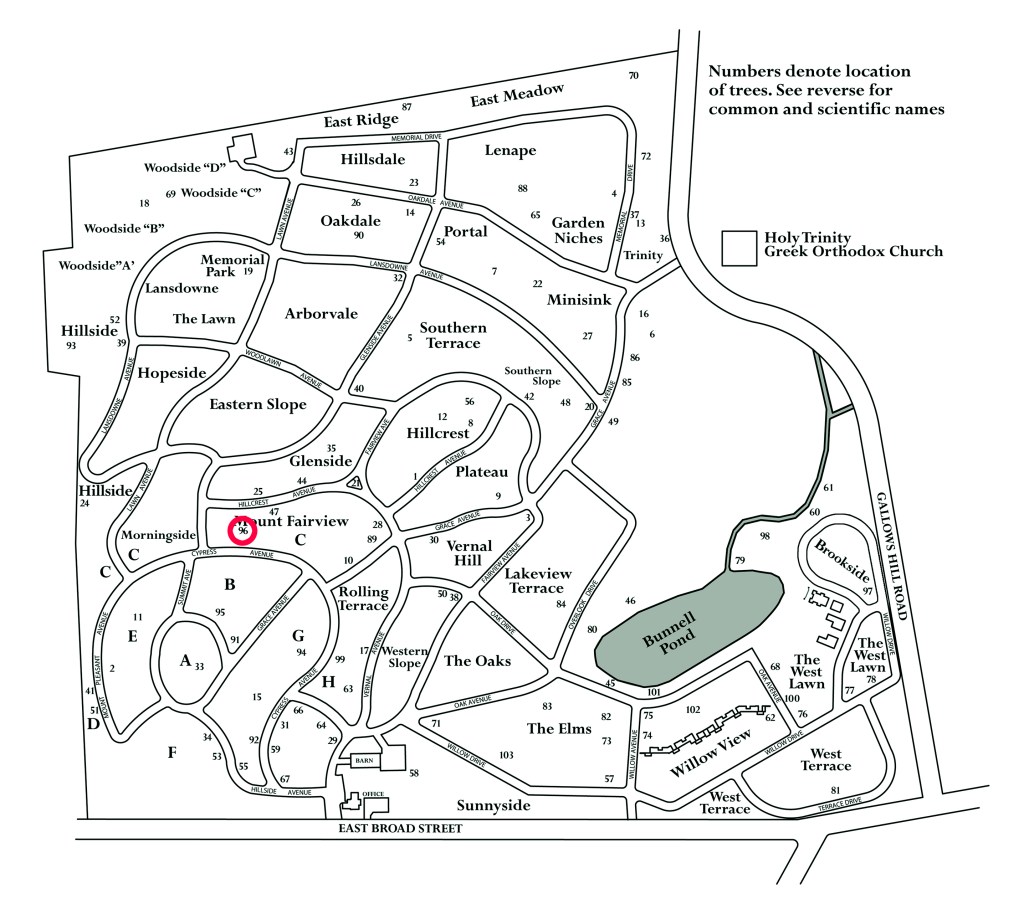
#96
Accession Number: 0096-0000
Common Name: London Plane Tree
Latin Name: Platanus × acerifolia
Family: Platanaceae (Plane Tree Family)
Native Range: Hybrid origin
Height: 75–100 feet
Spread: 60–75 feet
Bloom Time: April
Bloom Description: Yellow (male) and red (female)
USDA Hardiness Zone: 4
Light Preference: Full sun
Water Needs: Medium to wet
Notes: Works well as a shade tree, in a rain garden; fruit is showy; tolerates deer, clay soil, air pollution
Description: London Plane Tree (sometimes written as “Planetree”) is a hybrid cross between 2 species—American Sycamore (Platanus occidentalis) and Oriental Plane Tree (Platanus orientalis)—thought to have originated sometime in the 1600s. Purported to be tolerant of air pollution, it was planted in cities all across Europe and later all across the US. Similar to its American parent, it generally grows with a single trunk, to about 75-100’ or occasionally taller, with horizontal branching and a rounded canopy. Sometimes difficult to distinguish from American Sycamore, the London Plane Tree has longer lobes on its pointed leaves and the round, fluffy fruits appear in pairs rather than singly. A favorite ornamental feature of this large tree that its brown bark exfoliates in irregular-shaped pieces, revealing patches of creamy white colored inner bark. Mature trees typically display mottled white bark that facilitates identification from great distances. Leaves usually turn an unremarkable yellow-brown color in fall. The fuzzy, round fruits, dangling on long stems, turn brown in October and gradually disintegrate throughout the fall, as tufts of seeds are dispersed by the wind. Tree requires a large space and is rather messy for use as a street tree. Some cultivars are more susceptible to Sycamore Anthracnose than others.